From Two Weeks to Fifteen Minutes: How AI is Revolutionizing Web Design
The traditional web design process is getting a massive upgrade, and it's changing everything
1.10.2025
I remember my first web design project back in the early 2000s. We spent weeks going back and forth with clients, sketching wireframes on whiteboards, debating pixel placements, and arguing over button colors. It was exhausting, expensive, and honestly? Kind of fun in a masochistic way. But those days are rapidly becoming ancient history.
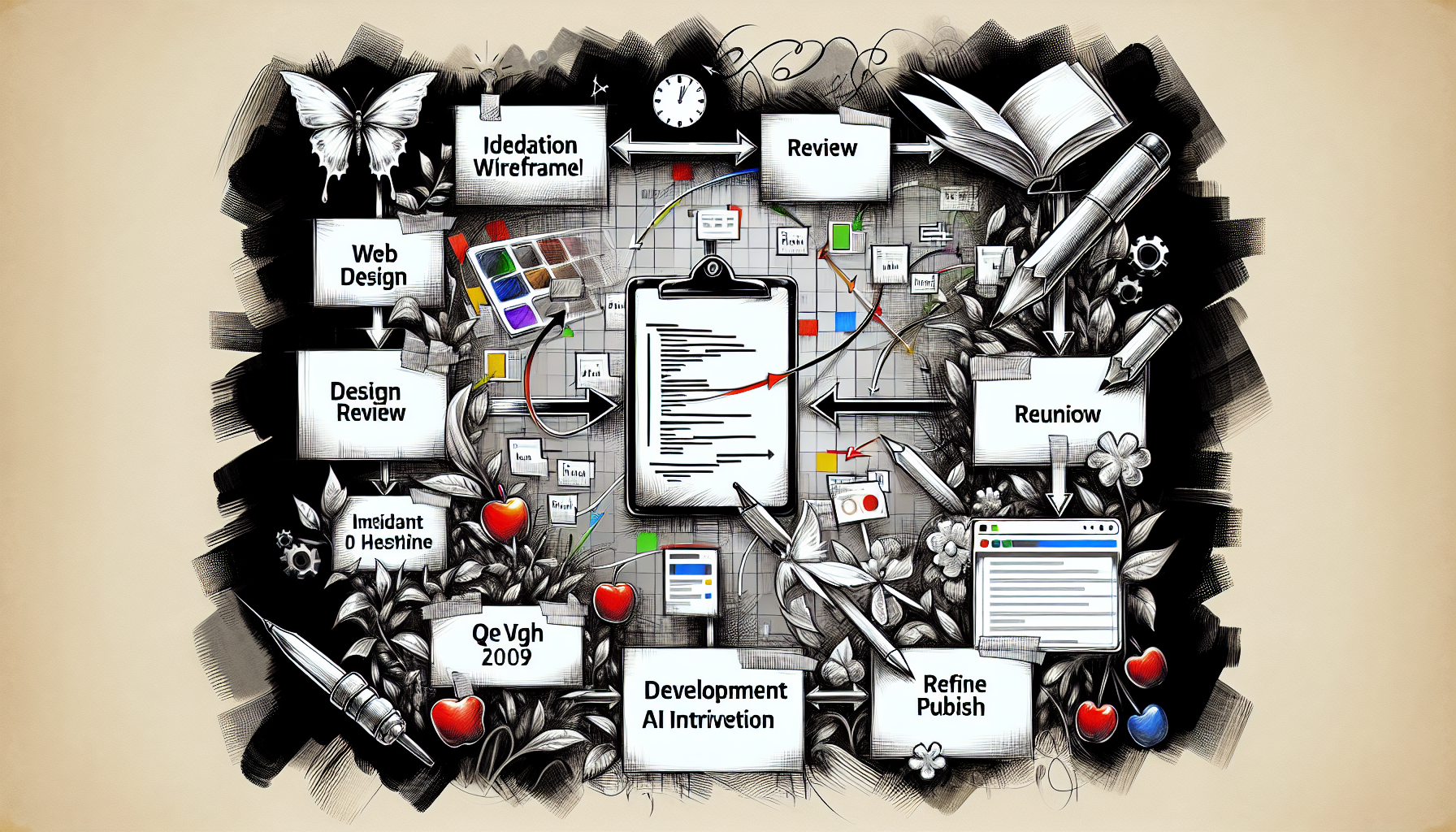
The traditional web design process has been pretty much the same for the past two decades. You'd start with ideation, move to wireframing, get client approval, create mockups, get more approvals, hand everything off to developers, wait for them to build it, test it in QA, refine based on bugs and feedback, and finally—if you're lucky—publish. The whole thing took about two weeks minimum, and that's if everything went smoothly. Which it never did.
The Old Way: A Two-Week Marathon
Let me break down what those two weeks actually looked like. Days 1-2 were spent in ideation meetings. Everyone threw ideas at the wall to see what stuck. You'd sketch concepts, debate target audiences, and create mood boards. It was creative, sure, but also chaotic.
Days 3-4 meant wireframing. This is where you'd outline the basic structure and layout without worrying about colors or fancy graphics. Think of it like creating a blueprint for a house. You're just figuring out where the rooms go, not picking paint colors yet.
Day 5 was review day. The client would look at your wireframes and inevitably want changes. "Can we move this? What if we tried that?" Back to the drawing board, literally.
Days 6-8 were design time. Now you'd add the visual polish—colors, typography, images, and all the aesthetic choices that make a website feel complete. This is where things got real and where designers either shined or struggled.
Day 9 brought another review. More feedback. More revisions. "The blue isn't quite right. Can we see it in teal?"
Days 10-12 were for development. Developers would take those beautiful designs and turn them into actual functioning code. HTML, CSS, JavaScript—the works. This was always the bottleneck because good developers are expensive and busy.
Day 13 meant QA testing. Does it work on mobile? What about Safari? Does that button actually do what it's supposed to do? You'd find bugs. Always bugs.
Day 14 was refinement and final touches. Fix the bugs, make last-minute tweaks, and pray nothing breaks.
Finally, you'd publish. Pop the champagne. Celebrate. Collapse from exhaustion.
The New Way: Fifteen Minutes to Launch
Now imagine doing all of that in fifteen minutes. Sounds impossible, right? That's exactly what AI is making possible today.
Here's the new workflow: You start with ideation just like before, but instead of days of meetings, you spend a few minutes clarifying what you want. You describe your vision to an AI—maybe you're building a portfolio site for a photographer, or an e-commerce store for handmade jewelry, or a blog about surfing in Rhode Island.
Then comes the magic part. Instead of wireframing, designing, reviewing, developing, and all those other steps, the AI just builds it. Instantly. It generates the layout, chooses appropriate colors and fonts, writes placeholder content, creates the structure, and outputs actual working code. What used to take two weeks happens in seconds.
The next ten minutes are spent refining. You look at what the AI created and make tweaks. "Make that header bigger. Change this section's background color. Move that image to the left." The AI updates everything in real-time.
Then you publish. That's it. Fifteen minutes from idea to live website.
What This Actually Means
The time savings are obvious and dramatic. But the real transformation goes deeper than just speed.
First, the barrier to entry drops dramatically. You don't need to hire a designer and a developer anymore. You don't need to understand the difference between margins and padding or what a div tag is. You just need a clear idea and the ability to communicate it.
Second, iteration becomes effortless. Want to try a completely different approach? Go ahead. It takes minutes, not weeks. You can experiment freely without worrying about burning through your budget or your team's patience.
Third, the cost difference is staggering. A traditional web design project might cost anywhere from $5,000 to $50,000 depending on complexity. With AI, you're looking at the cost of a software subscription—maybe $50 to $200 per month. That's not a typo. We're talking about a 100x reduction in cost.
The Human Element Still Matters
Here's where I need to be honest, though. AI isn't replacing human creativity or strategic thinking. Not yet, anyway. And maybe not ever.
The best results still come when you combine AI's speed with human judgment. The AI can generate a website quickly, but it doesn't understand your brand's personality or your audience's unspoken needs the way you do. It doesn't know that your target customer is a 35-year-old mom who checks Instagram while waiting in the school pickup line.
Think of AI as an incredibly fast assistant who can execute your vision instantly but still needs your direction. You're the director, and AI is the crew. You call the shots, and it handles the heavy lifting.
Real-World Application
I've been using AI in my own projects, and it's genuinely transforming how I work. Last month, I needed to spin up a landing page for a new product idea. Old me would have sketched wireframes, maybe hired a designer, definitely hired a developer, and spent at least a week and a few thousand dollars getting it live.
Instead, I described what I wanted to an AI tool, made some refinements, and had it published in about twenty minutes. Was it perfect? No. Did it accomplish everything I needed to validate my idea and start collecting email addresses? Absolutely.
That's the key insight. AI gets you from zero to 80% really fast. That last 20% of polish and perfection? That still takes human touch. But 80% is often good enough to test ideas, launch experiments, and move quickly.
The Old Skills Aren't Worthless
If you're a designer or developer reading this and starting to panic, take a breath. Your skills aren't obsolete. They're evolving.
Understanding design principles, user experience, accessibility, and visual hierarchy is still crucial. Knowing how to write clean code, optimize performance, and solve complex technical problems still matters. But now you can focus on the high-level strategy and creative problem-solving instead of spending hours pushing pixels or debugging CSS.
It's like what happened with calculators and math. Calculators didn't make mathematicians obsolete. They just freed them up to work on harder problems instead of spending all day doing arithmetic by hand.
What Comes Next
This is just the beginning. Right now, AI can handle relatively straightforward websites pretty well. But it's improving fast. Every month, the technology gets better at understanding context, creating more sophisticated interactions, and handling edge cases.
Within a few years, I think we'll see AI handling complex e-commerce platforms, custom web applications, and even sophisticated interactive experiences—all with the same speed and ease we're seeing with simple websites today.
The implications are huge for small businesses, entrepreneurs, and anyone with an idea they want to get online quickly. You won't need to save up thousands of dollars or spend weeks learning to code. You'll just need a clear vision and fifteen minutes.
My Take on All This
I've been building websites since the early 2000s. I've lived through the Flash era, the responsive design revolution, the mobile-first movement, and now AI automation. Every shift brings resistance from people who are comfortable with the old way.
But here's what I've learned: fighting these changes is pointless. The technology doesn't care about our feelings. It just keeps getting better and more accessible.
The smart move is to embrace it. Learn how to work with AI tools. Understand their strengths and limitations. Use them to move faster and experiment more freely. Then apply your uniquely human skills—creativity, empathy, strategic thinking—to make the output truly great.
From two weeks to fifteen minutes isn't just a time savings. It's a fundamental shift in how we think about creating for the web. And honestly? I'm here for it. The faster I can go from idea to execution, the more ideas I can test and bring to life.
Just don't ask me to design anything in Flash. Some eras should stay dead.
ai-web-design-flow-fifteen-minutes-1771911908021.png