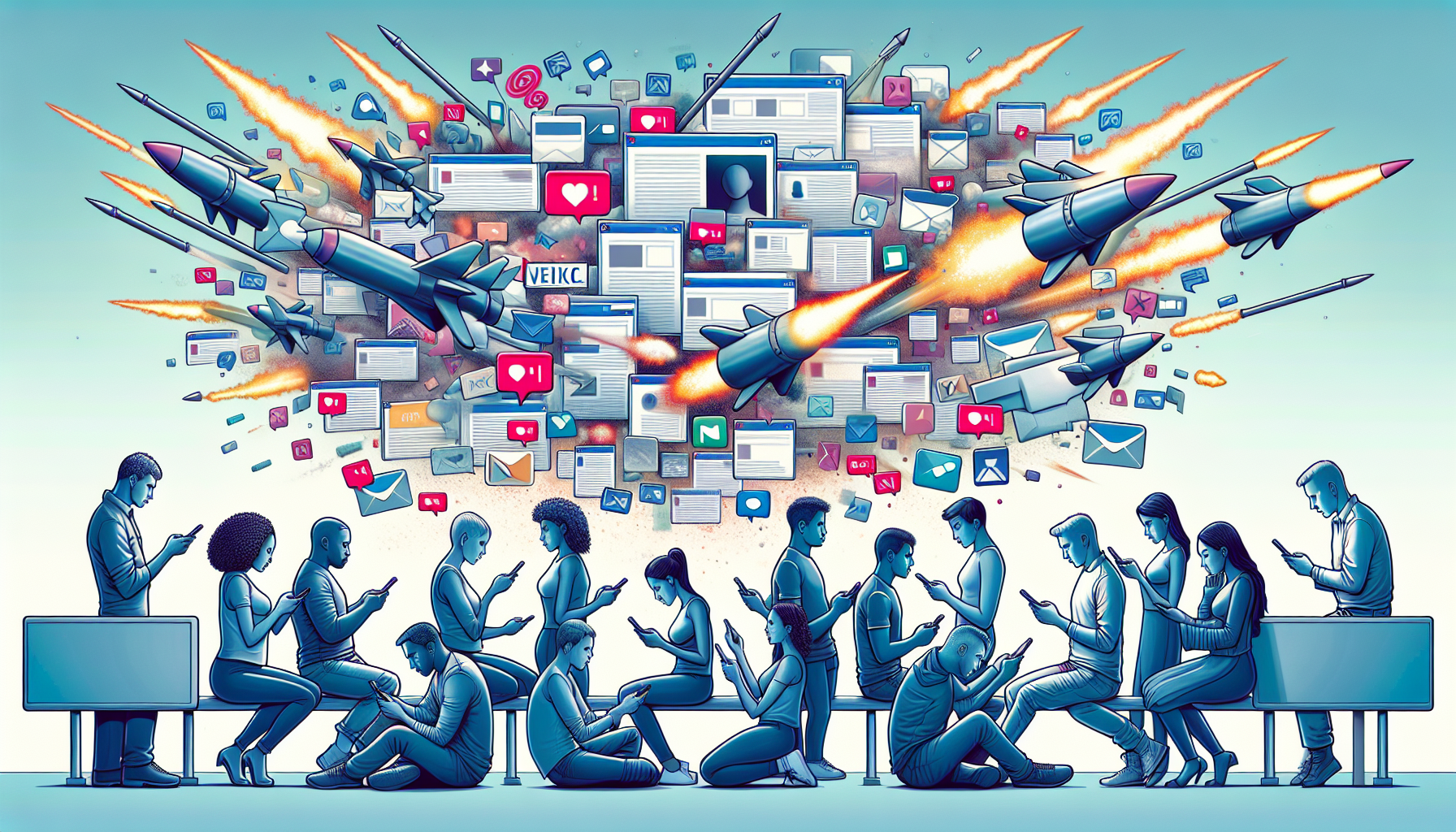
Content Wars: The Battle for Your Attention You Never Agreed to Fight
How the internet became a battlefield where billions of content pieces compete for your time, emotion, and identity—without anyone declaring war
1.9.2025
You didn't sign up for this. When you opened your laptop this morning, scrolled through your phone on the commute, or checked notifications during lunch, you probably didn't think: I'm entering a war zone. But you were.
Welcome to the Content Wars—a conflict with no uniforms, no borders, no formal declarations. Just screens. And an unfathomable amount of content fighting for the most valuable resource you possess: your attention.
The Battlefield Without Borders
Every second, the internet produces a staggering volume of material. YouTube users upload 500 hours of video every minute. Instagram sees 95 million photos and videos posted daily. Twitter—now X—processes hundreds of millions of tweets. TikTok, Facebook, LinkedIn, Substack, Medium, podcasts, newsletters, and a thousand other platforms join the fray.
Each piece of content is a soldier in this war. Every headline is engineered. Every thumbnail tested. Every notification timed. They're all designed with a singular purpose: to capture you. To hold you. To convert your finite attention into something measurable—a click, a view, a share, a purchase, a belief.
How Did We Get Here?
The transformation happened quietly. There was no moment when the internet changed from a tool into a battlefield. No press conference. No vote. It evolved piece by piece, algorithm by algorithm, engagement metric by engagement metric.
In the early days, the internet was a library—you went looking for information. Then it became a marketplace. Then a social space. Now? It's an arena where content creators, brands, influencers, news organizations, and algorithms compete in an endless tournament for your time.
The shift was subtle. Platforms realized that attention equals revenue. The longer you stay, the more ads you see, the more data you generate, the more valuable you become. So they optimized. They hired psychologists. They studied behavioral patterns. They built systems that learned what keeps you scrolling, clicking, watching.
The Weapons of Engagement
The tactics are sophisticated. Clickbait headlines that promise shock or revelation. Autoplay videos that start before you decide to watch. Infinite scroll that removes natural stopping points. Red notification badges that trigger urgency. Algorithms that show you content just provocative enough to make you angry, just relatable enough to make you share.
Even the timing is weaponized. Push notifications arrive when you're most likely to be vulnerable—early morning, late night, lunch breaks. The content itself is optimized for what's called "engagement," which sounds neutral but really means "reaction." Not thoughtfulness. Not depth. Reaction.
The Currency of War
What are these content pieces fighting for? Several things:
- Your time: Minutes and hours that could be spent elsewhere
- Your emotion: Outrage, joy, fear, desire—anything that creates investment
- Your belief: Shaping how you see the world, what you consider true
- Your money: Direct purchases or the attention that enables advertising revenue
- Your identity: The groups you join, the causes you support, the person you become online
These aren't abstract concepts. They're the actual stakes of the Content Wars. Every day, billions of micro-battles are fought for these resources, and most of us don't even realize we're participants.
No Neutral Ground
Perhaps the most disorienting aspect of the Content Wars is that there's no safe space, no neutral territory. Every platform is a battlefield. Every feed is curated by algorithms with agendas. Even the most innocuous-seeming content—recipe videos, pet photos, workout tips—exists within the same attention economy.
The cute dog video isn't just a cute dog video. It's content optimized for shareability, positioned to keep you on the platform, surrounded by ads or followed by more addictive content. The news article isn't just information. It's competing with thousands of other articles, optimized for clicks, often sacrificing nuance for engagement.
You can't opt out by choosing "better" content. You can only be more aware of the terrain.
The Casualty Report
What are we losing in these wars? Focus, for one. The ability to sustain attention on difficult or unrewarding material has measurably declined. Nuance, for another—complex ideas don't survive in an environment optimized for reaction. Shared reality is fragmenting as algorithms show each person a different version of the world.
Mental health metrics are alarming. Anxiety and depression rates, especially among young people, have climbed alongside social media usage. Sleep patterns are disrupted. Real-world relationships strain under the weight of digital comparison and distraction.
We're also losing time itself—hours per day absorbed into feeds and notifications, time that simply vanishes into the attention economy, converted into data and advertising revenue for platforms worth trillions.
Who's Winning?
Not you. Not me. The winners in the Content Wars are the platforms themselves—the attention brokers who've built infrastructure to capture, monetize, and sell human focus at massive scale.
Content creators aren't winning either, despite appearances. Most are trapped on treadmills of constant production, algorithm changes, and platform dependency. A few reach escape velocity. Most burn out.
Advertisers get access but decreasing returns as audiences grow numb to persuasion. News organizations get reach but lose revenue and trust. Politicians get amplification but increasing polarization.
Recognition Is the First Step
The Content Wars aren't going away. The attention economy is too valuable, too entrenched, too global to simply dissolve. But recognition changes things. When you understand that your attention is being fought over, you can start to make conscious choices about where to allocate it.
You can't win the Content Wars. But you can stop being an unwitting soldier in someone else's campaign. You can recognize the battlefield for what it is. You can choose, more deliberately, which battles deserve your time.
Because the uncomfortable truth is this: you didn't knowingly join this war, but you're in it anyway. Every time you pick up your phone, open an app, or click a link, you're back on the battlefield. The question isn't whether you'll engage with content today—you will. The question is whether you'll do it consciously or by reflex.
The Content Wars rage on. At least now you know you're fighting.
content-wars-battle-for-attention-1771568745145.png