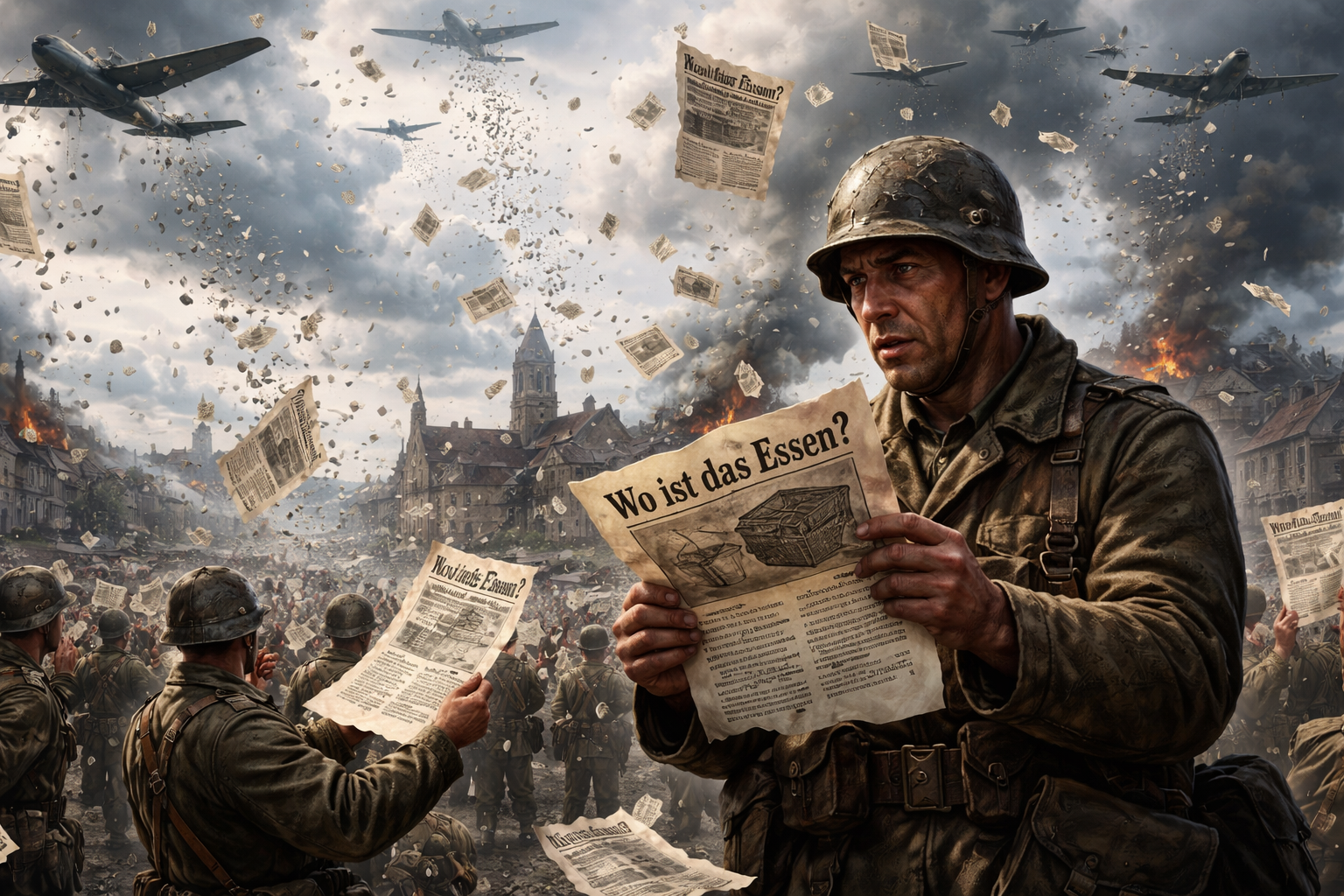
Content Wars Chapter 1: Wartime Propaganda
How Printed Flyers and a Mysterious Graffiti Artist Became Psychological Weapons in WWII
1.15.2025
The Paper Bombs That Fell From the Sky
During World War II, the United States military discovered that sometimes the most effective weapons weren't made of steel and explosives—they were made of paper and ink. As Allied forces pushed across Europe and the Pacific, American planes dropped millions of printed flyers over enemy territories, deploying psychological warfare at an unprecedented scale.
These weren't just random pieces of propaganda. They were carefully crafted messages designed to undermine enemy morale, sow confusion, and plant seeds of doubt in the minds of both soldiers and civilians. One of the most effective tactics involved convincing enemy forces that they were running out of critical supplies—particularly food.
Starvation Propaganda: The Hunger Games of WWII
American propaganda teams created elaborate flyers depicting empty German and Japanese supply depots, accompanied by messages suggesting that the Axis powers were on the brink of collapse. The leaflets painted vivid pictures of Allied abundance while claiming enemy rations were dwindling to nothing.
Some flyers included detailed "intelligence reports" about food shortages in specific regions, complete with fabricated statistics and testimonials from supposed defectors. Others showed photographs of well-fed Allied soldiers enjoying hearty meals, contrasted with warnings that enemy supply lines had been cut off.
The psychological impact was real. Even when enemy troops had adequate supplies, the constant barrage of messaging created anxiety and distrust. Soldiers began questioning their own supply chains, hoarding rations, and wondering if their commanders were telling them the truth about the war's progress.
The Allies Are Winning: Manufacturing Momentum
Beyond food scares, American propaganda relentlessly hammered home the message that Allied victory was inevitable. Flyers depicted advancing Allied forces on maps, listed captured territories, and proclaimed that resistance was futile. The goal wasn't just to inform—it was to create a self-fulfilling prophecy where enemy forces, believing defeat was certain, would lose the will to fight.
These leaflets often included safe-conduct passes, promising humane treatment to soldiers who surrendered. The combination of fear (you're losing, you're starving) and hope (you can survive if you give up) proved remarkably effective. Thousands of enemy soldiers carried these passes when they surrendered, and post-war interviews revealed that propaganda had significantly impacted their decision.
Kilroy Was Here: The Graffiti That Launched a Thousand Rumors
But perhaps the most psychologically disruptive element of American wartime messaging wasn't official propaganda at all—it was a simple piece of graffiti: "Kilroy was here."
The mysterious phrase, typically accompanied by a cartoon of a bald man with a prominent nose peering over a wall, began appearing everywhere American troops went. And we mean everywhere—on bridges, inside captured bunkers, on bathroom walls in occupied buildings, even in the most secure German facilities.
The Phantom American
What started as an inside joke among American servicemen became an inadvertent psychological operation. German and Japanese officers would secure a facility, lock it down, and conduct thorough inspections—only to find "Kilroy was here" scrawled in a latrine or scratched into a wall. How did he get there? When? Who was this Kilroy?
The graffiti appeared in places that should have been impossible to access. German officers would find it in their private quarters, in newly constructed bunkers that were supposedly secure, and in locations that hadn't yet been captured by Allied forces. The implication was terrifying: American intelligence was so sophisticated that they had operatives everywhere, even in the heart of German command.
The Bounty on a Ghost
The psychological impact on German forces was so significant that, according to post-war accounts, German high command actually placed a bounty on Kilroy's head. They desperately wanted to capture or kill this master infiltrator who seemed to be mocking them at every turn.
Of course, there was no single Kilroy. The phrase had originated with American shipyard inspector James J. Kilroy, who chalked the words on equipment he'd inspected. Servicemen adopted it, and it spread like wildfire. But the Germans didn't know that. To them, Kilroy represented an omnipresent American spy network, a ghostly figure who could penetrate their most secure locations.
The beauty of Kilroy's psychological impact was its simplicity. Every instance created doubt, paranoia, and the unsettling feeling that nowhere was safe. German officers wasted time and resources investigating security breaches, interrogating their own men, and worrying about infiltration that didn't exist.
Content as Weaponry
The story of WWII propaganda and the Kilroy phenomenon illustrates a timeless truth: content isn't just information—it can be a weapon. Whether through carefully crafted leaflets designed to demoralize enemy troops or through an accidental viral campaign that created phantom threats, the words and images deployed during wartime shaped perception, influenced behavior, and ultimately affected outcomes.
These early "content wars" demonstrate that the battle for hearts and minds can be just as important as the battle on the ground. The Americans understood that making the enemy believe they were losing could be as effective as actually defeating them in combat.
As we explore the evolution of content in this series, keep in mind that from the very beginning, those who mastered messaging held tremendous power—and sometimes, the simplest messages proved the most effective. After all, three words and a cartoon character created more paranoia than entire divisions of troops.
In the next chapter, we'll explore how these wartime propaganda techniques evolved into the advertising boom of the 1950s, where the battlefield shifted from trenches to living rooms, and the weapons became commercials and brand messaging.