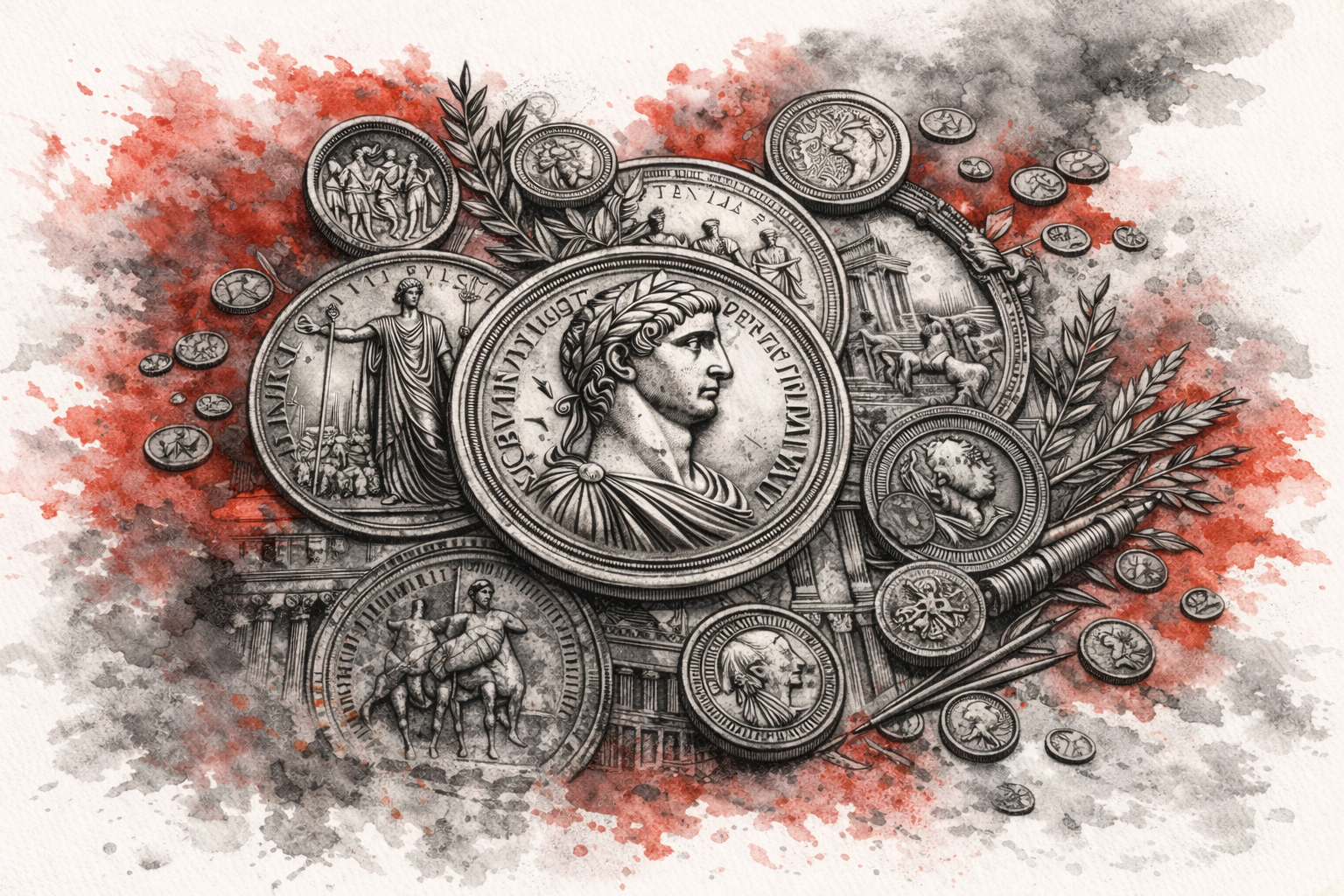
Content Wars Chapter 6: Fiat and Coin Content
How Roman Coins Became History's First Mass Media and the Ancient World's Most Powerful Marketing Tool
1.20.2025
The World's First Mass Media Platform
Long before Gutenberg's printing press revolutionized information distribution in 1440 CE, the Roman Empire had already mastered mass communication through an ingenious medium: coins. Roman coinage represents perhaps the most successful content marketing campaign in ancient history, transforming cold metal into powerful propaganda that reached every corner of the known world.
What makes Roman coins extraordinary as a communication medium is their durability and ubiquity. Unlike papyrus scrolls that deteriorated or stone inscriptions fixed in place, coins were non-malleable objects that traveled through countless hands, crossed borders, and survived millennia. Each transaction became an opportunity for imperial messaging, making coins the ancient world's equivalent of viral content.
Faces of Power: Imperial Branding on Metal
The practice of placing portraits on coins began in earnest during the late Roman Republic. Julius Caesar was among the first living Romans to appear on coins around 44 BCE, breaking a long-standing taboo. This wasn't mere vanity—it was strategic content marketing. By placing his likeness on currency, Caesar ensured that millions of people across the empire would recognize his face, building what we'd now call brand recognition.
The aureus, denarius, and sestertius became billboards for imperial propaganda. Emperor Augustus perfected this technique, issuing coins that depicted not just his portrait but carefully curated messages about his achievements. According to numismatic scholar David Sear in "Roman Coins and Their Values," Augustus issued over 400 different coin types during his reign, each telling a specific story about military victories, building projects, or divine favor.
War Propaganda in Your Pocket
Roman coins served as miniature war bulletins, announcing victories before news could travel by messenger. When Emperor Trajan conquered Dacia (modern Romania) in 106 CE, he issued coins proclaiming "DACIA CAPTA" (Dacia Captured) with imagery of defeated barbarians. These coins circulated throughout the empire, ensuring that even illiterate citizens in distant provinces understood Roman military supremacy.
The reverse sides of coins became canvas for propaganda narratives:
- Military Victories: Depictions of conquered territories, defeated enemies, and triumphal arches
- Divine Right: Images linking emperors to gods, suggesting divine approval of their rule
- Public Works: Representations of aqueducts, temples, and amphitheaters demonstrating civic achievement
- Political Legitimacy: Family connections and succession narratives to justify power transitions
As historian Andrew Burnett notes in "Coinage in the Roman World," these weren't random images but carefully orchestrated campaigns designed by imperial moneyers working directly under state supervision.
The Technology of Non-Malleable Content
The genius of using coins as a medium lies in their physical properties. Unlike wax tablets that could be erased, papyrus that could burn, or wood that could rot, metal coins were remarkably durable. Bronze, silver, and gold resisted tampering and environmental degradation. This non-malleability meant the message remained unchanged as it passed through generations.
The minting process itself was a form of mass production. Coin dies—engraved metal stamps—could produce thousands of identical impressions before wearing out. According to T.V. Buttrey's research in "Documentary Evidence for the Chronology of the Flavian Titulature," Roman mints could produce up to 30,000 coins per die, creating true mass media distribution centuries before the printing press.
The process worked like this:
- Master engravers created obverse (front) and reverse (back) dies with approved imagery
- Blank metal discs called flans were heated to the proper temperature
- Workers placed flans between dies and struck them with hammers
- Each strike created an identical message-carrying object
- Coins entered circulation, distributing content through normal economic activity
Effectiveness Analysis: Ancient Content Marketing ROI
Measuring the effectiveness of Roman coin propaganda requires examining both reach and impact. The numbers are staggering. During the Principate period (27 BCE - 284 CE), Roman mints produced hundreds of millions of coins. These reached every social class, from senators to slaves, and every geographic region, from Britannia to Mesopotamia.
Reach Metrics:
The Roman economy was thoroughly monetized by the 1st century CE. Soldiers received salaries in coins, merchants conducted trade with coins, and tax collection required coins. This meant virtually every adult in the empire handled coins regularly. Unlike elite literacy—estimated at only 10-15% of the population—coin imagery was accessible to all. Visual propaganda transcended language barriers across the multilingual empire.
Longevity Metrics:
Coins remained in circulation for decades, sometimes centuries. A denarius minted under Augustus might still be exchanging hands under Nero, continuously reinforcing the Julio-Claudian dynasty's legitimacy. This extended exposure created lasting brand awareness for imperial messaging.
Credibility Metrics:
The medium itself conveyed authority. Coins represented government-backed value, and their metallic permanence suggested unchanging truth. As historian Olivier Hekster writes in "Coins and Messages: Audience Targeting on Coins of Different Denominations," the very act of minting coins was an assertion of sovereignty—only legitimate authorities could issue currency.
Case Study: Vespasian's Judaea Capta Campaign
Perhaps no Roman coin series better demonstrates propaganda effectiveness than the Judaea Capta ("Judaea Captured") issues following the Jewish Revolt (66-73 CE). Emperor Vespasian and his son Titus issued dozens of coin types celebrating their victory, depicting palm trees (symbolizing Judaea) and mourning Jewish captives.
These coins served multiple purposes:
- Legitimized the Flavian dynasty's rise to power through military success
- Communicated Roman dominance to restive provinces
- Celebrated the capture of Jerusalem and destruction of the Temple
- Funded reconstruction projects using war spoils (including the Colosseum)
The campaign's success is evident in its duration—Judaea Capta coins were minted for over 25 years, long after the military victory, suggesting continued propaganda value.
Limitations and Countermeasures
Despite their effectiveness, Roman coin propaganda faced limitations. Opposing forces could issue their own coins with counter-narratives. During civil wars, rival claimants minted competing currencies, each proclaiming their legitimacy. The usurper Carausius, who controlled Britain from 286-293 CE, issued coins with flattering messages comparing himself to earlier "good emperors," attempting to build legitimacy through content marketing.
Additionally, coin messages could be misinterpreted or ignored. In "Reading Roman Coins," Martin Jehne argues that modern scholars may over-interpret coin propaganda's sophistication, suggesting ancient audiences might have paid less attention to imagery than we assume. However, the Romans' continued investment in elaborate coin designs suggests they believed in the medium's power.
A Monumental Step in Content Marketing History
Roman coins represent a pivotal evolution in content distribution technology. They solved fundamental challenges that plague all content marketers:
Distribution: Economic necessity ensured delivery to target audiences without additional marketing costs. Every transaction was a touchpoint.
Credibility: Government backing and intrinsic metal value made the medium trusted, lending authority to the message.
Persistence: Non-malleable metal preserved content across time and space without degradation.
Scalability: Die-striking technology enabled mass production while maintaining message consistency.
Universality: Visual communication transcended literacy and language barriers.
These characteristics made Roman coins arguably more effective than early printed materials. While Gutenberg's press required literate audiences, coin propaganda worked for everyone. While printed pamphlets could be destroyed or decay, metal coins survived fires, floods, and centuries of handling.
Legacy: From Ancient Coins to Modern Content
The principles Roman coin propagandists mastered remain relevant to modern content marketing. They understood that effective content requires:
- Ubiquity: Messages must reach audiences where they already are
- Consistency: Repeated exposure reinforces brand recognition
- Authority: The medium's credibility affects message reception
- Visual Impact: Images communicate faster than text
- Durability: Lasting content provides ongoing value
Modern parallels are everywhere. Social media platforms are our coins—small, easily shared pieces of content that circulate through networks. Viral content, like widely circulated coins, multiplies its reach through organic sharing. Memes, with their reproducible formats and persistent messages, function remarkably like standardized coin designs.
Even cryptocurrency has revived ancient Roman practices. Bitcoin and other digital currencies use cryptographic "minting" to create non-malleable digital objects that carry inherent value while facilitating transactions. Some cryptocurrencies even incorporate imagery and messaging in their designs, echoing Roman propaganda strategies.
Conclusion: The First Printing Press Was Made of Metal
When we think of mass communication revolutions, we typically cite Gutenberg's printing press as the starting point. But Roman coins preceded movable type by 1,500 years, achieving many of the same outcomes: standardized reproduction, wide distribution, and persistent messaging.
The Romans didn't just mint money—they minted meaning. Each coin was a tiny ambassador carrying imperial narratives into every corner of the known world. They transformed currency from mere economic instruments into powerful content platforms, creating the ancient world's most successful marketing campaign.
In the Content Wars—the perpetual struggle to capture attention and shape narratives—Roman coins represent a crucial chapter. They demonstrated that the medium truly is the message, that durability extends influence, and that mass production of content could shape public opinion on an unprecedented scale.
The next time you examine ancient Roman coins in a museum, recognize them for what they truly were: not just archaeological artifacts, but the world's first mass-produced content, the ancient printing press, and perhaps history's most enduring marketing campaign.
References and Further Reading
- Burnett, Andrew. "Coinage in the Roman World." Seaby, 1987.
- Buttrey, T.V. "Documentary Evidence for the Chronology of the Flavian Titulature." Meisenheim am Glan, 1980.
- Hekster, Olivier. "Coins and Messages: Audience Targeting on Coins of Different Denominations." In "The Representation and Perception of Roman Imperial Power," 2003.
- Jehne, Martin. "Reading Roman Coins: Audience and Intention." In "A Companion to the Roman Army," Blackwell, 2007.
- Sear, David R. "Roman Coins and Their Values." Spink & Son, 2000.
- Sutherland, C.H.V. "Roman Coins." Barrie & Jenkins, 1974.
- Howgego, Christopher. "Ancient History from Coins." Routledge, 1995.
- Levick, Barbara. "Propaganda and the Imperial Coinage." Antichthon 16, 1982.
- Wallace-Hadrill, Andrew. "Image and Authority in the Coinage of Augustus." Journal of Roman Studies 76, 1986.
content-wars-chapter-6-fiat-and-coin-content-1771640297098.png