Content Wars Chapter 3: Corporate Propaganda via Live Electrocution
How Corporate Rivalry Led to One of History's Most Disturbing PR Stunts
1.15.2025
The War of Currents
A dark story in the history of content wars where the live execution of an animal was spun and used to sway people in a mass marketing campaign.
In the late 1880s, two brilliant minds were locked in a fierce battle that would determine the future of electrical power in America. Thomas Edison, already a household name and champion of direct current (DC), faced a formidable challenger in Nicola Tesla, whose alternating current (AC) technology promised to revolutionize how electricity could be transmitted over long distances.
What began as a technical debate quickly descended into one of the most ruthless corporate propaganda campaigns in American history—a campaign that would culminate in the public execution of an elephant.
Edison's Desperate Campaign
By the early 1890s, Edison was losing ground. Tesla's AC system, backed by George Westinghouse, proved superior for long-distance transmission, requiring fewer power stations and thinner wires. Edison's DC system could only transmit electricity effectively for about a mile, making it impractical for widespread electrification.
Faced with obsolescence, Edison launched a campaign to portray AC current as deadly and dangerous. He began publicly electrocuting animals—dogs, cats, horses, and even a calf—using AC current to demonstrate its lethal potential. Edison's team coined the term "Westinghoused" as slang for being electrocuted, directly attacking his competitor's brand.
Topsy the Elephant
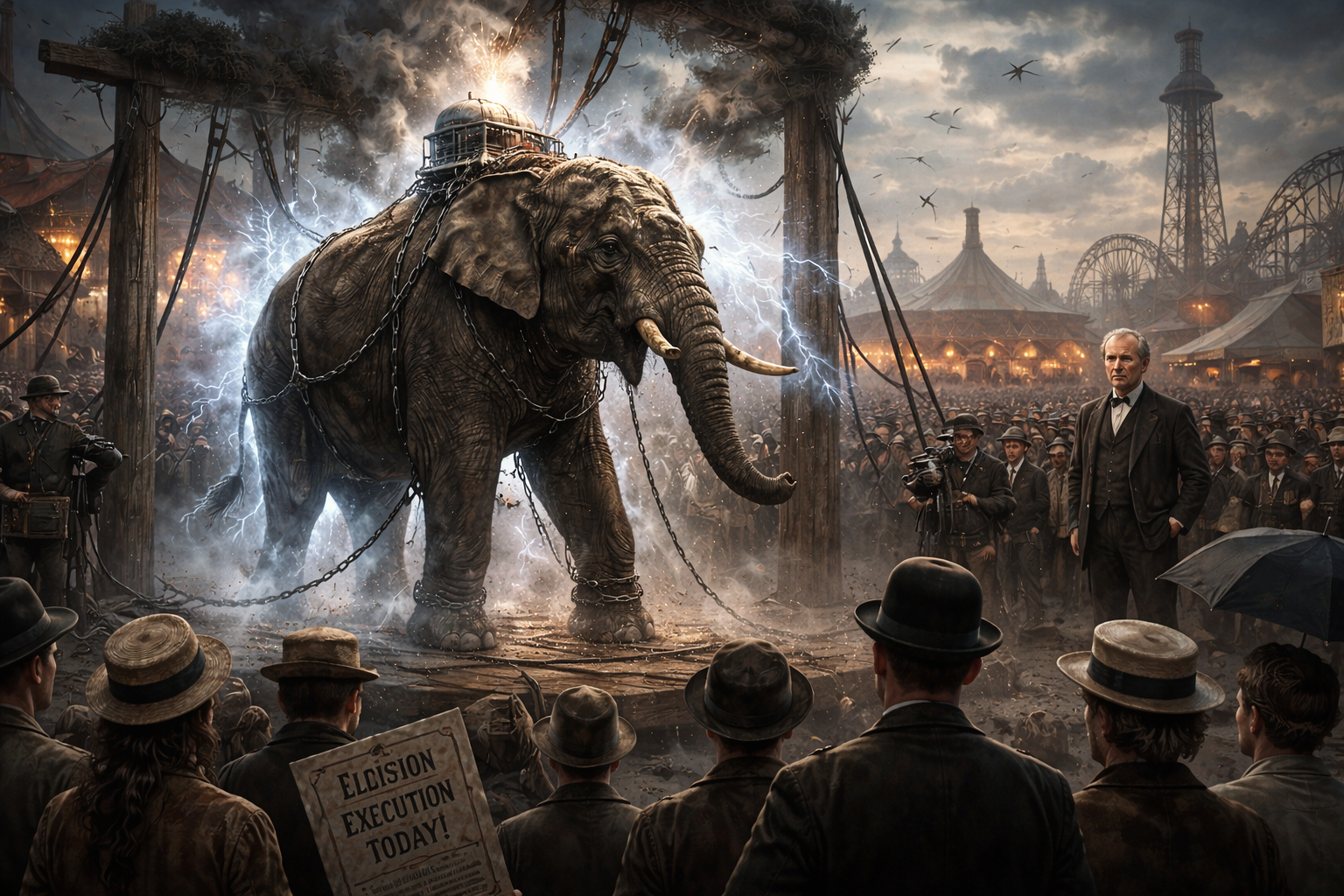
The most notorious episode in this propaganda war occurred on January 4, 1903, at Coney Island's Luna Park. Topsy, a circus elephant who had killed three men over her lifetime (including an abusive trainer who fed her a lit cigarette), was deemed dangerous and sentenced to death.
The park's owners initially planned a public hanging, but the ASPCA protested this method as inhumane. Edison's company saw an opportunity. They offered to electrocute Topsy using AC current—a final, spectacular demonstration of alternating current's dangers.
The Truth About Topsy's Death
What many accounts of this incident obscure is a crucial detail: the electrocution itself did not kill Topsy. Before the 6,600 volts of AC current were applied, handlers fed Topsy carrots laced with 460 grams of potassium cyanide—enough poison to kill dozens of elephants.
When the current was finally switched on, Topsy was already dying from the poison. She collapsed within seconds, smoke rising from her feet where the electrodes were attached. The entire event was filmed by the Edison Manufacturing Company and distributed as "Electrocuting an Elephant," becoming one of the earliest examples of propaganda cinema.
The execution was engineered to ensure a quick, visually dramatic death that could be attributed solely to AC electricity. The poisoning was a backup plan—insurance that the demonstration wouldn't fail in front of the 1,500 spectators and news reporters gathered to witness the spectacle.
Propaganda That Worked on the Masses
Edison's campaign was remarkably effective, despite its ethical bankruptcy. The visceral horror of watching animals die in public demonstrations created a powerful emotional response that overshadowed technical facts and engineering superiority.
Newspaper coverage sensationalized the dangers of AC current. The film of Topsy's execution was shown in penny arcades and nickelodeons across the country, reaching audiences who had never seen an elephant, let alone witnessed such a disturbing spectacle. The message was clear and simple: AC electricity kills.
This emotional appeal proved more persuasive to the general public than Tesla's superior engineering. People didn't understand voltage, resistance, or transmission efficiency, but they understood the terrifying sight of a dead elephant.
The Irony of Scientific Progress
Despite Edison's efforts, AC current ultimately prevailed. The technical advantages were simply too great to suppress with propaganda alone. By the early 20th century, AC had become the standard for power transmission worldwide—the very standard we still use today.
Edison himself eventually adopted AC technology in his companies, quietly abandoning the system he had championed so viciously. The corporate propaganda campaign failed in its ultimate objective, but succeeded in delaying progress and tarnishing Tesla's reputation for years.
Legacy of Corporate Manipulation
The electrocution of Topsy represents an early template for corporate propaganda: exploit public emotion, create spectacular demonstrations, control the narrative through media distribution, and obscure inconvenient facts (like the poison) that complicate the message.
This episode revealed how corporate interests could manipulate public opinion through staged events and emotional appeals, prioritizing profit and market share over truth and scientific progress. It established patterns of corporate behavior that would repeat throughout the 20th century—from tobacco companies denying cancer links to fossil fuel companies sowing doubt about climate change.
The War of Currents taught us that superior technology doesn't always win on merit alone. Public perception, shaped by propaganda and spectacle, can delay scientific progress for years. And sometimes, the most memorable moment in a corporate war is also the most shameful.
References
Essig, M. (2003). Edison and the Electric Chair: A Story of Light and Death. Walker & Company.
Jonnes, J. (2003). Empires of Light: Edison, Tesla, Westinghouse, and the Race to Electrify the World. Random House.
McNichol, T. (2006). AC/DC: The Savage Tale of the First Standards War. Jossey-Bass.
Daly, M. (2013). "Topsy the Elephant Was a Victim of Her Captors, Not Thomas Edison." Smithsonian Magazine.
Carlson, W. B. (2013). Tesla: Inventor of the Electrical Age. Princeton University Press.
"Electrocuting an Elephant" (1903). Edison Manufacturing Company. Library of Congress Motion Picture Collection.
topsy.jpg
poor-topsy-elephant.jpg
topsy-in-chains.jpg