The Human Network of Information
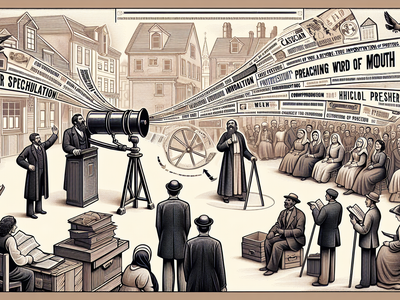
Before Johannes Gutenberg revolutionized communication with the printing press in the 15th century, information traveled through the most reliable network available: human voices. In an era when literacy rates hovered below 10% in most European societies, and hand-copied manuscripts remained the exclusive domain of wealthy monasteries and nobility, the spoken word ruled supreme. At the center of this oral information ecosystem stood a powerful class of communicators—street preachers and religious leaders who transformed word of mouth into a systematic, far-reaching distribution network.
The Street Preacher: Medieval Content Creator
Street preachers were the viral content creators of their time. Standing on corners, in marketplaces, and at town squares, these charismatic orators delivered messages that ranged from religious instruction to political commentary, from moral guidance to community news. Unlike the cloistered clergy who ministered exclusively within church walls, street preachers took their message directly to the people, meeting audiences where they lived, worked, and gathered.
The most famous of these medieval communicators was perhaps Peter the Hermit, whose passionate preaching about the First Crusade in 1096 mobilized thousands of peasants across Europe. Without writing a single word, Peter's message spread like wildfire through oral repetition—each listener becoming a broadcaster, each conversation a new transmission point. His success demonstrated the explosive potential of word-of-mouth communication when combined with compelling content and emotional resonance.
Saint Francis of Assisi exemplified another model of street preaching in the early 13th century. Rejecting the formal Latin of official church services, Francis preached in the Italian vernacular, making his message accessible to common people. He understood that effective communication required meeting audiences in their own language, a principle that remains fundamental to content strategy today. His followers, the Franciscan friars, adopted his approach and became a distributed network of communicators, spreading consistent messages across Europe while adapting delivery to local contexts.
John Wycliffe's followers, known as Lollards, created an organized system of itinerant preachers in 14th-century England. These preachers memorized key passages and arguments, then traveled from village to village delivering standardized content with local variations. They represented an early attempt at scalable content distribution—maintaining message consistency while enabling personalized delivery.
The Church as Information Infrastructure
While street preachers captured attention in public spaces, the established church provided the infrastructure for systematic information distribution. Parish churches served as weekly gathering points where communities assembled not just for worship but for news, announcements, and instruction. The Sunday sermon functioned as a regularly scheduled broadcast, reaching audiences with remarkable consistency.
Pastors and priests occupied a unique position in the information hierarchy. They received instruction and content from bishops, who in turn received guidance from higher ecclesiastical authorities, creating a top-down content distribution network. A papal decree, theological interpretation, or political message could cascade through this system, reaching from Rome to the smallest village church, translated and interpreted at each level.
The pastor's pulpit became a powerful platform. In an age without newspapers, radio, or television, the weekly sermon represented the primary channel through which most people received information about the wider world. Skilled preachers understood their role as mediators between complex theological or political concepts and local audiences. They simplified, illustrated with stories, and connected abstract ideas to concrete daily experiences—techniques modern content creators would recognize immediately.
Bishop Fulbert of Chartres in the 11th century exemplified the systematic approach to clerical communication. He trained his priests not just in theology but in effective delivery, emphasizing clarity, repetition, and memorable phrasing. He understood that content quality meant nothing if audiences couldn't understand, remember, or retell the message.
The Propagation System: From Pulpit to Community
The true genius of the medieval word-of-mouth system lay not in the initial delivery but in the propagation mechanism that followed. Information didn't stop at the church door; it radiated outward through a sophisticated social network.
The propagation began with the congregation itself. Sunday services brought together diverse community members—merchants, farmers, craftsmen, servants, and occasionally nobility—who would otherwise occupy separate social circles. After the service, these individuals dispersed to their respective networks, carrying the message with them. The merchant discussed the sermon with customers and trading partners. The craftsman shared insights with apprentices and guild members. Servants brought news to noble households. Each conversation spawned additional conversations, creating exponential reach.
Families served as critical nodes in the distribution network. Information shared at church traveled home, where it was discussed over meals, recounted to children, and debated by extended family members. Mothers taught religious lessons to children, who then shared these stories with playmates, embedding messages in the next generation. The family dinner table functioned as a content replication center, ensuring that even those who missed church—due to illness, work obligations, or age—still received the core message.
The medieval workplace provided another propagation channel. Guild meetings, market gatherings, and collaborative work situations created opportunities for information exchange. A memorable sermon would be recounted, debated, and interpreted multiple times throughout the week. Particularly compelling or controversial messages could dominate conversation for weeks, their ideas evolving through each retelling.
Traveling workers—journeymen craftsmen, merchants, pilgrims, and seasonal laborers—carried messages across geographic boundaries. A sermon heard in London might be retold in Bristol a week later, then appear in modified form in York the following month. This geographic distribution happened organically, without coordination, as travelers naturally shared interesting information encountered during their journeys.
Quality Control and Message Mutation
The oral propagation system had inherent strengths and weaknesses. On the positive side, it was resilient, democratic, and adaptive. Messages couldn't be censored by destroying documents because they existed in thousands of memories. No literacy requirement excluded potential audiences. Content naturally adapted to local contexts as each reteller adjusted details, examples, and emphasis for their specific audience.
However, this same flexibility created quality control challenges. Messages mutated as they spread. Details were forgotten, misremembered, or deliberately altered. A nuanced theological point might be oversimplified into folk wisdom. Political messages could be distorted by personal biases. The further information traveled from its source, the less reliable it became.
The church attempted to maintain message integrity through several mechanisms. Standardized prayers, creeds, and liturgical responses were taught through repetition and memorization, creating anchor points of unchanging content. Regular training sessions for clergy helped ensure consistent interpretation of doctrine. The authority structure discouraged unauthorized variation—deviation from official teaching could result in accusations of heresy.
Memorable content design also improved propagation accuracy. Preachers used rhyme, rhythm, and alliteration to make messages easier to remember. Biblical stories provided narrative frameworks that were harder to distort than abstract concepts. Vivid imagery—burning hellfire, glorious heaven, dramatic miracles—created mental pictures that persisted through multiple retellings. Repetition of key phrases ensured that at least the central message survived the propagation process intact.
The Economics of Oral Distribution
Word-of-mouth information distribution operated on different economic principles than written communication. Oral content required no material resources—no parchment, no ink, no copying labor. The primary investment was time: the preacher's time in preparation and delivery, the audience's time in listening and attendance. This made information distribution far more accessible and egalitarian than manuscript-based systems, where high material costs restricted access to wealthy institutions.
However, oral systems faced scaling challenges. A preacher could only address audiences within voice range. Message reach depended on audience size and subsequent propagation, which couldn't be precisely controlled or predicted. Geographic distribution was slow and unpredictable, dependent on travel patterns and social networks.
The church's solution was to create a geographically distributed network of churches and preachers. By placing parish churches within walking distance of most population centers, and training a distributed workforce of clergy, the church achieved impressive coverage. Sunday services created a regular schedule that audiences could depend on, while traveling preachers and religious orders provided supplemental content distribution.
Competition in the Attention Economy
Street preachers and church pastors competed for audience attention not just with each other but with alternative information sources. Town criers delivered civic announcements. Traveling entertainers told stories and sang ballads that often contained news and social commentary. Informal gossip networks buzzed with local scandals and rumors. Effective preachers needed to make their content more compelling than these alternatives.
The most successful preachers understood audience psychology. They opened with attention-grabbing statements or questions. They used dramatic pauses and voice modulation to maintain interest. They incorporated local references and current events to demonstrate relevance. They told stories that audiences could visualize and remember. They created emotional experiences—fear, hope, guilt, inspiration—that motivated audiences to share the message.
Controversial content spread faster than bland orthodoxy. Preachers who challenged authority, predicted apocalyptic events, or exposed social injustice generated buzz that extended their reach. This created a tension between institutional message control and viral propagation potential—a tension that remains central to content strategy today.
Legacy and Lessons
The medieval word-of-mouth system established patterns that persist in modern content distribution. The importance of memorable framing, emotional resonance, and audience understanding. The power of distributed networks where each recipient becomes a broadcaster. The challenge of maintaining message integrity while enabling propagation. The competition for limited attention resources.
Modern content creators who dismiss historical precedents as irrelevant to the digital age miss crucial insights. The mechanics of viral spread that drive social media success mirror the propagation patterns of medieval sermons. Influencer marketing replicates the street preacher model—charismatic individuals building audiences through authentic connection. Content calendars echo the regular schedule of Sunday services. Community building and audience engagement remained central whether the platform is a medieval marketplace or Twitter.
The printing press would soon revolutionize information distribution, enabling unprecedented scale, accuracy, and speed. But it didn't eliminate the power of spoken communication or the importance of word-of-mouth propagation. Instead, it created new hybrid models where printed content and oral distribution reinforced each other. Understanding how information flowed before printing provides essential context for understanding how content ecosystems evolved afterward—and how they continue to evolve today.
The street preachers and pastors of medieval Europe were content strategists working with the technology available to them. They understood their audiences, crafted compelling messages, optimized for memorability and propagation, and built systems for reliable distribution. Their successes and failures offer lessons that transcend specific platforms or technologies, revealing enduring principles of effective communication in the eternal content wars.